Tai Po inferno:
Hong Kong’s deadliest fire in decades
November 30, 2025
Last update: December 1 2025, 05:45pm
A disaster that will long be burned into Hong Kong’s collective memory ignited on Wednesday afternoon, November 26, 2025, at the Wang Fuk Court housing complex in Tai Po, New Territories. The fire quickly spread, engulfing seven of the eight 31-storey towers.
-
Wednesday, November 26 | ~2.51pm
A fire is reported on the podium at the base of the building. Authorities said mesh netting caught fire and soon spread upward. -
Wednesday, November 26 | ~3.02pm
Escalates to a No 3 alarm fire; the first group of firefighters arrive at the scene.
The blaze reached an unprecedented scale, escalating to the maximum Level 5 emergency. Hong Kong watched in shock and horror as the residential towers - covered in bamboo scaffolding and green mesh netting for renovation works - were engulfed in flames while firefighters battled to free trapped residents.
-
Wednesday, November 26 | ~3.34pm
Upgraded to a No 4 alarm fire 30 minutes later. The fire spreads with unusual speed. -
Wednesday, November 26 | Midnight
At 6.22pm upgraded to No 5 alarm, the highest level in Hong Kong, as the inferno rages.The death toll rises to 36 after midnight, as another 279 people remain missing.
It was Hong Kong’s worst fire in more than seven decades, and was only brought under control two days later. It resulted in the deaths of at least 151 people*, left dozens injured, and many more missing. In the wake of the disaster, 14 people have been arrested as investigations were launched into repair works and the presence of flammable materials.
*Casualty toll as of December 1, 2025
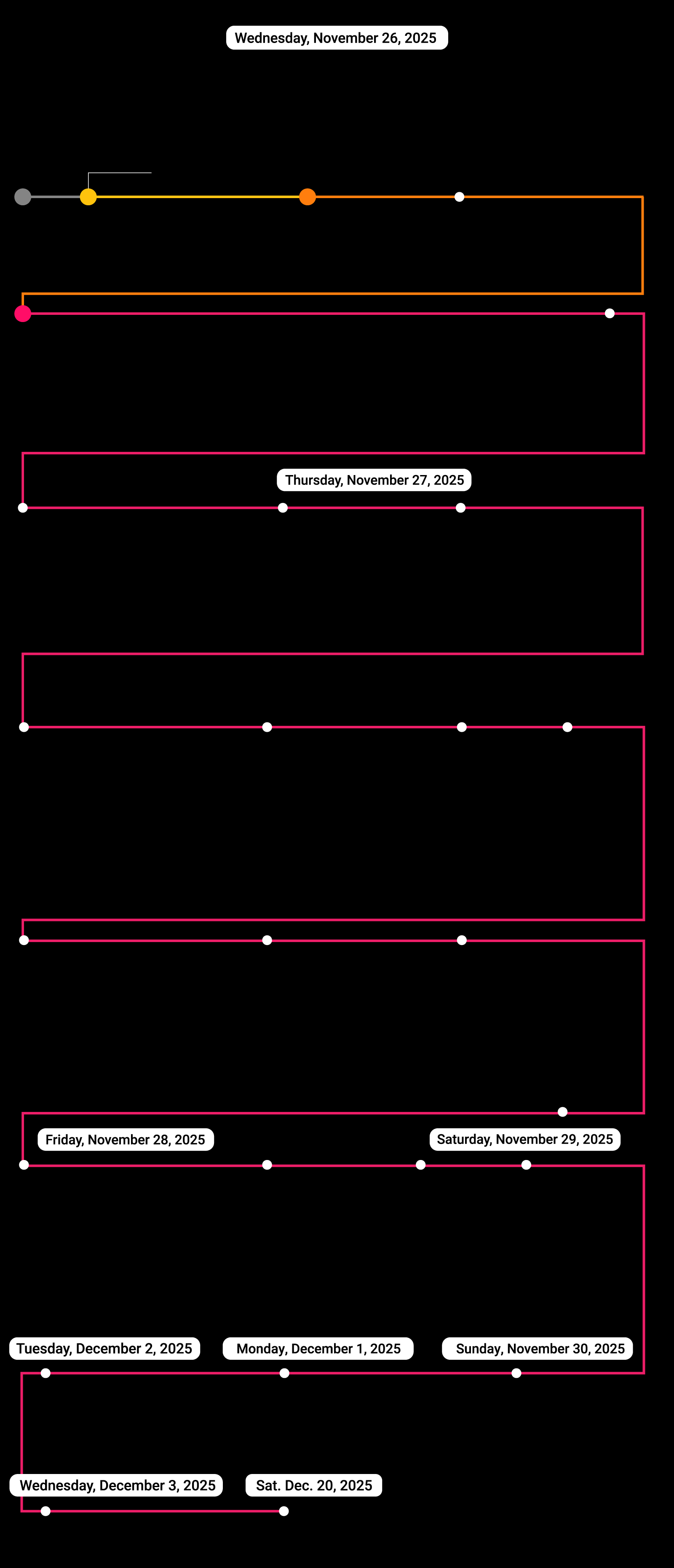
Late afternoon
The inferno
is initially
classified as a
No 1 alarm fire.
Flames and thick smoke spread across at least five adjacent buildings. Over 700 firefighting and medical personnel, along with over 200 vehicles, are dispatched. Hundreds of residents begin evacuation.
Escalated to
No 3 alarm fire.
Upgraded to a No 4 alarm fire.
3.02pm
3.34pm
2.51pm
Fire is first reported at Wang
Cheong House, burning mesh
netting and bamboo
scaffolding of the tower.
A firefighter at the scene loses contact with his team. He is rescued half an hour later and declared dead at 4.45pm.
Evening
6.22pm
Authorities open nearby schools to serve as temporary shelters for approximately 700 to 900 evacuees. The official death toll rises to 13 as hundreds of firefighters and police actively work at the scene. A firefighter is among the dead.
No 5 alarm fire.
Upgraded to a No 5 alarm, the highest level in Hong Kong, as the inferno rages. High temperatures and falling debris severely challenge firefighting efforts.
Late night
After midnight
Overnight
China’s President Xi Jinping expresses his condolences and calls for “all-out efforts” to minimise casualties and losses. Hong Kong Chief Executive John Lee Ka-chiu visits a temporary shelter after chairing an emergency meeting.
The death toll rises to 36, as another 279 people are missing. Hong Kong leader Lee calls the fire a “catastrophe”.
Three people, including two directors and a consultant of the contractor, are arrested for manslaughter, as about 20 bodies are removed from the scene.
The Independent Commission Against Corruption (ICAC) sets up a task force to investigate potential corruption related to the deadly fire.
3.30pm
Early morning
2pm
3pm
The fire is reported under control in four of the seven affected blocks. The death toll rises to 44, surpassing the Garley Building fire in 1996 that claimed 41 lives and becoming the deadliest blaze in Hong Kong.
Initial investigation shows protective nets, tarpaulins and plastic sheets - materials failing to meet fire safety standards - are used for the maintenance works. Foam boards are also found installed to the windows of the buildings.
The death toll rises to 55, with 51 found dead at the scene. Another 15 are in critical condition. Firefighters have attended to 279 calls for help but not been able to reach 62 cases.
6pm
8pm
10pm
As many as 65 people have been confirmed dead, with 70 injured, including 10 firefighters.
The death toll rose to 75, with 76 injured, including 11 firefighters.
The death toll remains at 55 with firefighters rescuing 55 survivors, while fires in all seven blocks are now under control. City leader Lee announces HK$300 million will be put into a fund to assist the victims and HK$10,000 will be distributed to each affected household by Thursday night.
Death toll rises to 83.
By midnight
Afternoon
Evening
8am
Afternoon
The death toll rises to 128, with 79 injured. The status of 200 people remains unclear. Some 89 bodies are unidentifiable. Secretary for Security Chris Tang Ping-keung says extinguishing and rescue efforts are mostly finished.
ICAC says it has made eight arrests in its probe into the fire.
The three-day mourning
period begins.
China’s State Council
Safety Committee
orders a nationwide
“investigation and
rectification
campaign” to
eliminate major fire
risks in high-rises.
Afternoon
Afternoon
The new death toll stands at 151, and the total number of people arrested rises to 14.
Death toll rises to 146 as bodies are found in flats, stairwells and rooftops. Dozens of people are missing.
Wang Fuk Court was undergoing renovation work when it caught fire. The project was deemed mandatory after housing authorities flagged the residential complex for a building and window inspection in 2016 due to its age.
The roughly HK$300 million (US$38.6 million) renovation was met with objections from some residents over its expense. Despite the mandatory order, the project took eight years of planning and finally began in January 2024. It was originally scheduled for completion by the second quarter of 2026.
Flammable materials
The residential towers were covered by bamboo scaffolding and draped with green mesh netting, a standard practice in Hong Kong during renovation works. However, officials have said that mesh netting, waterproof tarpaulins and plastic cloths at the estate did not meet safety standards. A preliminary investigation found that highly flammable polystyrene foam was used to seal windows on each floor.
Bamboo scaffolding
Hong Kong is one of the last places in the world where bamboo is still widely used for scaffolding in construction. It is flexible, strong and cheaper than steel and aluminium. Bamboo, as a material, is usually resistant to ignition, as it retains a significant amount of moisture, which slows combustion. But bamboo was a factor in the severity of the Tai Po disaster as the fires were so ferocious they burned the scaffolding, parts of which collapsed as the structures weakened. Fallen bamboo and other debris were reported to hinder firefighters’ operations.
In the wake of the disaster, Chief Secretary Eric Chan Kwok-ki said the government would discuss with the construction industry how to transition fully from bamboo to steel scaffolding as soon as possible.
The fire was first detected among bamboo scaffolding materials near lower levels of Wang Cheong House (Block F).
The mesh netting may have contributed to a chimney effect, creating strong upward convection that drives extensive, rapid fire growth.
Raging fires destroyed bamboo structures, sending flaming debris crashing to the ground.
Debris can accelerate the spread and intensity of fires.
Fire spreads rapidly to adjacent blocks, ultimately engulfing seven towers.
Wind
Strong winds helped fan the flames and push the fire across the scaffolding, spreading the blaze from the first building to catch fire (Wang Cheong House) to six adjacent residential blocks in the densely packed complex.
Fire alarms
The Director of Fire Services Andy Yeung Yan-kin said fire alarms of all eight buildings did not sound during the department’s tests. The failure of fire alarms during the deadly blaze is believed to have significantly delayed the evacuation of residents. Survivors said they were unaware of the impending danger because they did not hear any alarms when the fire first broke out, highlighting a crucial lapse in the buildings’ safety system.
Use of polystyrene foam
The discovery of highly flammable polystyrene foam will no doubt be closely scrutinised in investigations. The material was used to seal windows on many floors near the lift lobbies. This allowed the fire to spread rapidly within the blocks and prompted window panes to shatter, escalating the fire and spreading it indoors. Some residents also said that the sealed windows made it difficult for them to know what was happening outside.
Hong Kong’s firefighters were put to the ultimate test by unprecedented conditions and the sheer scale of the inferno, which raged across multiple buildings simultaneously. Their work was made more challenging as firefighting equipment - ladders and hoses - could only manage to reach just over halfway up the 31-storey towers, as the fire spread rapidly to the upper floors.
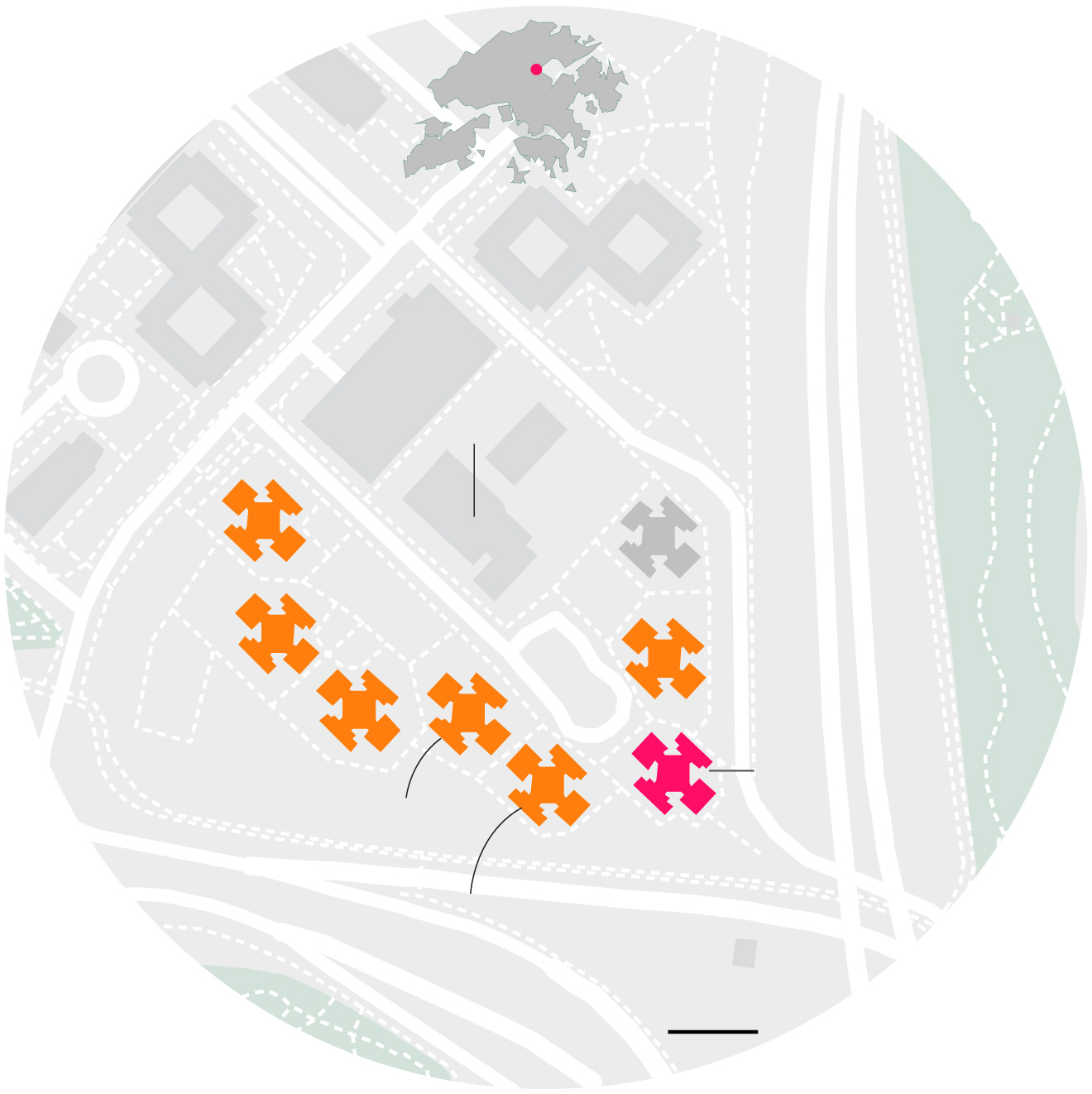
Tai Po
Kwong Fuk
Estate
Kwong Lai
House
Tai Po
Yuen Shin Road
Tai Po International
Baptist Church
Yuen Chau
Tsai Park
Wang Yan
House
Wang Fuk
Court
Wang Kin
House
Fire spread to
Wang Shing House
Wang Tao
House
Fire started at
Wang Cheong House
Wang Sun House
Kong Fuk Road
Wang Tai House
30m
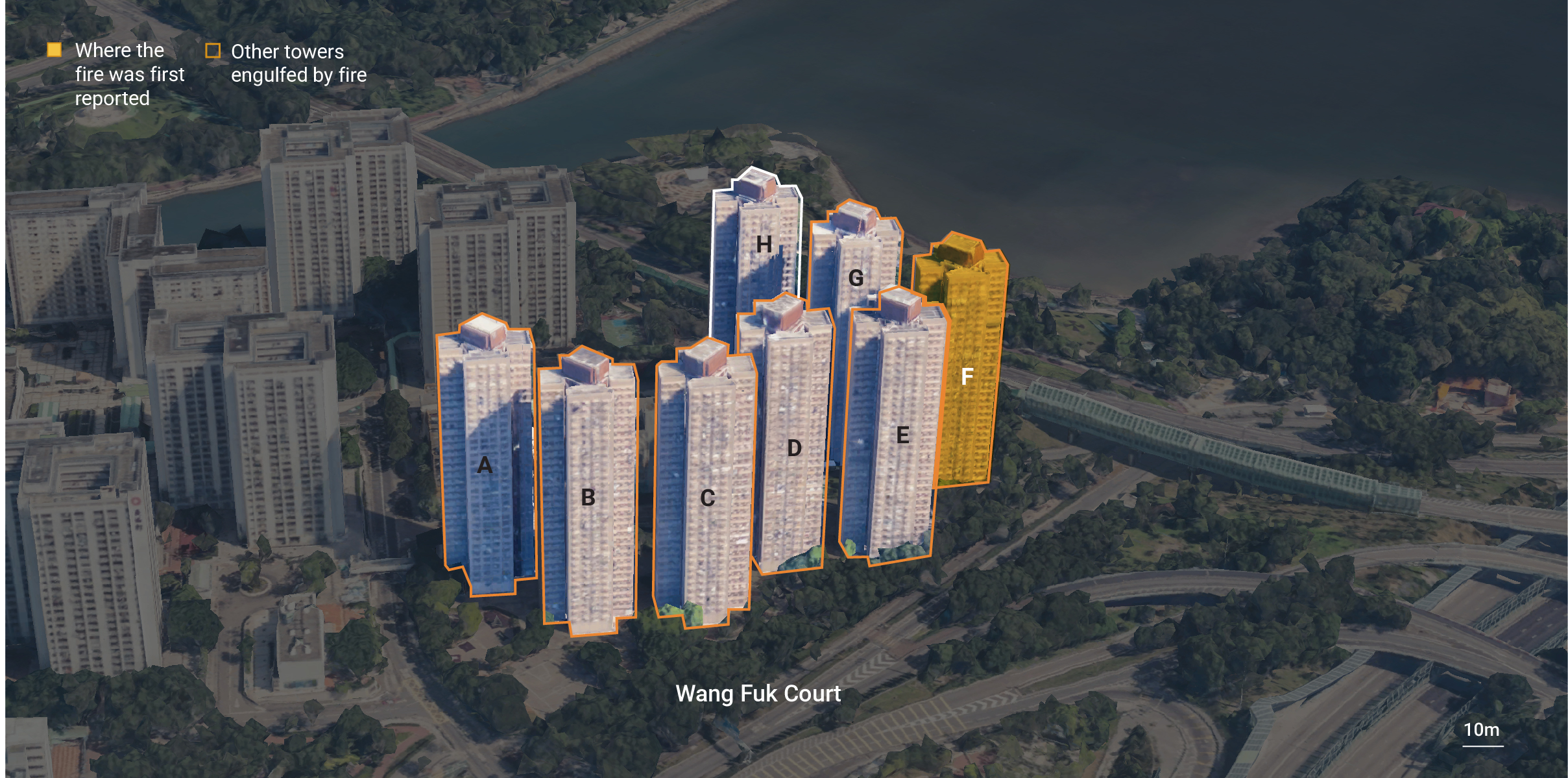

Wang Fuk Court is a subsidised home-ownership complex in Tai Po. Built in 1983, its eight 31-storey towers are among the tallest buildings in the district, housing around 4,600 people.
Wang Cheong House (Block F), the building where the fire was first reported, is among the highest populated blocks in Wang Fuk Court.
Many people were at home when the fire started as more than 50 per cent of the residents in Wang Fuk Court are considered non-working.
Nearly 40 per cent of residents are aged 65 and above.
Counting the casualties
Recovery teams searched the charred ruins of the towers in the aftermath of the fire, raising the death toll as the human cost became clearer. Hospitals treated the injured as government agencies and the Hong Kong community stepped in to help residents left homeless by the disaster.
Fires of record in Hong Kong
The 2025 Wang Fuk Court inferno stands as Hong Kong’s deadliest blaze in more than seven decades. Here is a look at some of the deadliest and notable fires in the city’s recent history.
2024 New Lucky House in Yau Ma Tei
Five people were killed and 43 others injured after an intense fire broke out in the 60-year-old New Lucky House on Jordan Road in Yau Ma Tei, which had subdivided units and 35 registered guest houses.
One of the five killed was suspected to have jumped off the 16-storey building in a bid to escape the blaze.
Firefighters found plastic boards and electric wiring installed in the first-floor lobby, which were possibly the source of the fire and dense smoke that spread across different floors.
2016 Amoycan Industrial Centre
Two firefighters died in an inferno that engulfed the Amoycan Industrial Centre in Ngau Tau Kok.
The blaze burned for more than 100 hours, making it the longest-running fire in more than 20 years.
A major obstacle for firefighters was the layout of 200 mini-cubicles inside the multiple-floor mini-storage facility where the fire began, each of them separated by metal sheets, and storing unknown goods..
The eight-storey building, which was built in 1961, was also not equipped with sprinklers, a requirement imposed on complexes built since 1973.
2011 Fa Yuen Street
A connection problem with an electrical cable used at a hawker’s stall in Mong Kok triggered an inferno through two adjoining eight-storey buildings at 192 and 194 Fa Yuen Street, leaving nine dead, 34 injured and 118 people homeless.
The danger was compounded by a lack of access to rear staircases in two buildings behind the market because flats had been subdivided.
1997 Top One Karaoke
A fire at Top One Karaoke in Tsim Sha Tsui killed 17 people and injured 15. A criminal trial found the arson was the result of a petty dispute between the Wo Shing Wo and Sun Yee On triad groups.
A coroner’s inquest found Top One Karaoke inspectors overlooked glaring breaches in fire safety equipment that should have been fixed.
These included an illegal system that cut off the water supply to sprinklers if closed off by a valve, an alarm system that should have been installed to warn the building owners if the valve was closed, and an obstructed sprinkler valve.
The fire led to an overall review of fire safety at entertainment venues across the city.
1996 Garley Building
A blaze that raged for 21 hours in the Garley Building on Nathan Road in Jordan claimed 41 lives, including a firefighter, and injured 81.
The fire started when a piece of hot metal fell from the 13th floor to the second, but as ongoing welding work had routinely triggered alarms, no one paid attention at first. Sparks and molten metal started the blaze in the lobby on the second floor where combustible materials, such as newspaper and wood, were stacked.
The Garley Building fire was Hong Kong’s deadliest in decades before the Tai Po tragedy.
1971 Jumbo Floating Restaurant
The Jumbo Floating Restaurant was engulfed in flames before its scheduled opening, killing 34 workers. Hundreds of people leapt from its pagoda-shaped towers to escape. The four-deck palatial establishment was reduced to a charred hulk.
Sparks from a welding machine were the cause of the fire. Six small fires had broken out in the same part of the vessel in the days leading up to the disaster as contractors raced to meet the restaurant’s opening date. The restaurant was rebuilt and opened in 1976.
1948 Wing On godown
One of the worst fires in the history of Hong Kong broke out after an explosion in a Wing On godown on Des Voeux Road West. It killed 176 people and injured 69 others. The five-storey godown contained dangerous goods, including celluloid and crepe rubber on the ground floor, while the upper four storeys comprised 36 tenement flats. That came a year after a fire broke out on the SS Sai On, a steamer ship moored at a wharf at Connaught Road, Central, killing 149 of the 200 passengers on board.
1918 Happy Valley Racecourse
The deadliest fire in Hong Kong’s history dates back to 1918, when a blaze erupted at Happy Valley Racecourse. More than 600 lives were lost after the grandstand collapsed.

請先 登入 以發表留言。